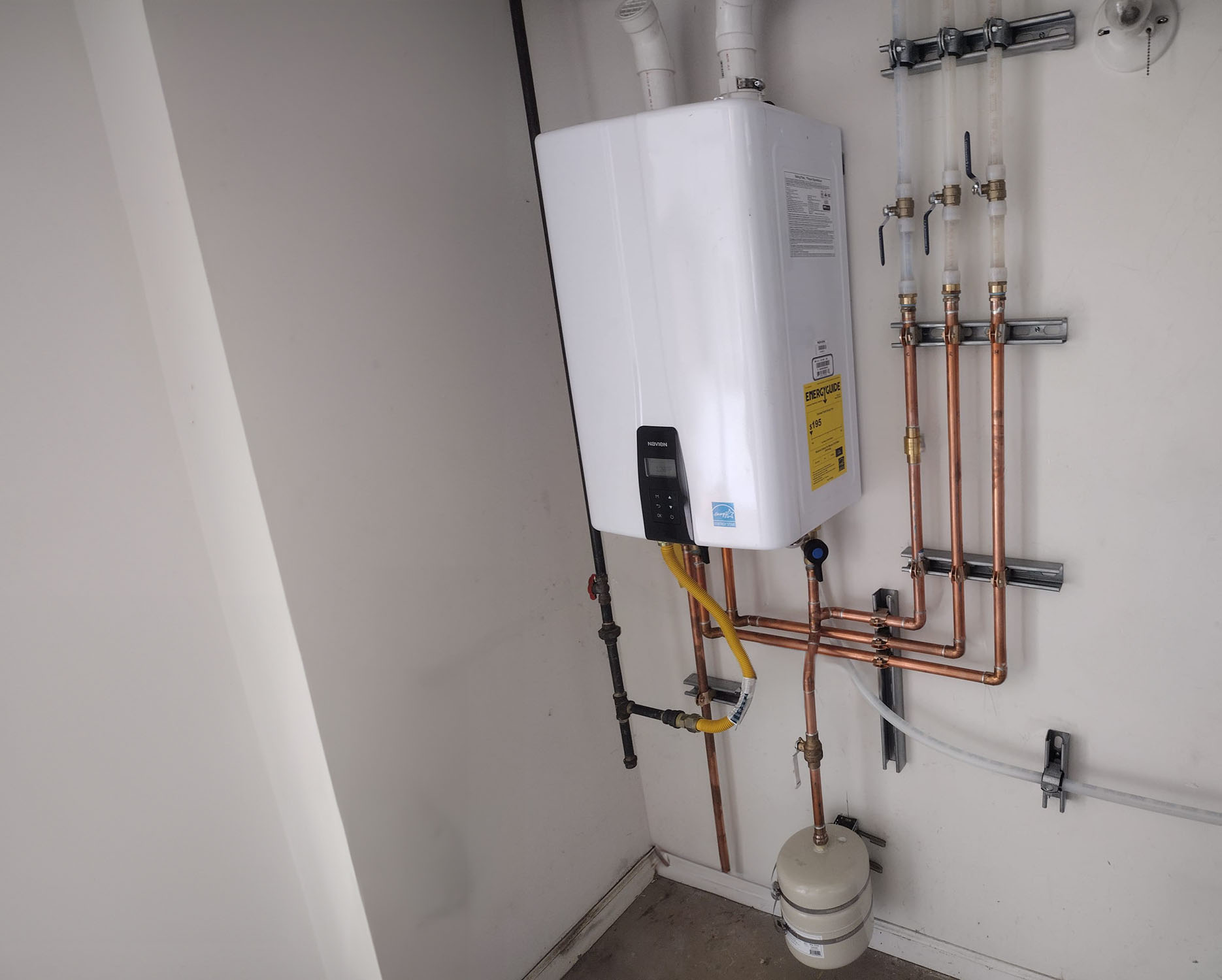

Tankless Water Heater Install
Your trusted partner for professional home services. Quality workmanship, guaranteed satisfaction.

Tankless Water Heater Install | Plumbing | Chattanooga
Imagine unlimited hot water flowing through your home seamlessly and efficiently. With HEP's expert tankless water heater installation in Chattanooga, that dream becomes a reality. Our skilled technicians are dedicated to providing top-notch service, ensuring your new tankless system fits perfectly, operates flawlessly, and brings a new level of comfort to your daily life. Say goodbye to bulky tanks and hello to an endless, eco-friendly hot water supply. Experience the convenience of cutting-edge technology and the reliability of HEP Plumbing today. Transform your home, reduce your energy bills, and enjoy the luxury of on-demand hot water!
What Our Customers Say


Advancing Home Comfort With Tankless Water Heater Installation in Chattanooga
Chattanooga’s vibrant mix of historic bungalows, contemporary townhomes, and sprawling foothill estates creates an eclectic set of plumbing demands. Many dwellings still rely on decades-old storage tanks that struggle to keep up with modern hot-water loads and the city’s fluctuating utility prices. By contrast, a professionally installed tankless water heater from HEP transforms domestic comfort, trims monthly energy consumption, and frees square footage that can be repurposed for storage or living space.
HEP’s plumbing division has refined a local-first approach that accounts for the Tennessee River Valley’s humid climate, seasonally shifting groundwater temperatures, and the intricate permitting requirements enforced within Hamilton County. When these factors are addressed from the outset, homeowners receive a seamless transition to endless hot water without the headaches often associated with major mechanical upgrades.
Why Tankless Technology Fits Chattanooga Households
• Fast-growing urban districts, such as Southside and Northshore, frequently feature compact utility closets where traditional storage tanks monopolize usable space.
• Mountain-edge homes perched on Lookout Mountain or Signal Mountain encounter sizable temperature swings between winter and summer. Tankless units modulate combustion or electric heating in real time, attaining efficiency across varied inlet temperatures.
• The region’s rising demand for eco-conscious living encourages systems that reduce greenhouse gas emissions and water waste; tankless technology excels on both fronts.
Environmental Advantages in the Tennessee River Valley
Chattanooga’s history as a manufacturing hub means residents are keenly aware of air-quality metrics. A high-efficiency tankless water heater curbs carbon output by eliminating stand-by losses that plague conventional tanks. Over a ten-year period, homeowners can prevent thousands of pounds of CO₂ from entering the atmosphere, supporting ongoing efforts to keep the Scenic City’s air clear. Additionally, tankless systems often integrate low-NOx burners that satisfy stringent emission standards, aligning with municipal sustainability goals.
HEP’s Specialized Approach To Tankless Water Heater Projects
While tankless units are available at big-box stores, optimal performance hinges on precise sizing, meticulous installation, and attentive after-care—all core competencies of HEP’s plumbing team. The company’s licensed technicians undergo ongoing manufacturer training, giving them a deep familiarity with the latest gas and electric models as well as smart-connected accessories.
Detailed Home Assessment
A comprehensive site evaluation is the cornerstone of every HEP installation. Technicians measure peak flow requirements by factoring faucet counts, shower fixtures, and simultaneous appliance usage. They also inspect gas pressure or electrical panel capacity to determine whether utility upgrades are necessary. The resulting recommendations are tailored; a three-bath Signal Mountain home with a whirlpool tub receives a different configuration than a downtown loft occupied by a single professional.
Local Code Knowledge And Permitting
Hamilton County and the surrounding municipalities apply National Fuel Gas Code and International Plumbing Code guidelines—yet each jurisdiction establishes unique amendments. HEP’s field supervisors submit permit applications, schedule in-progress inspections, and meet with code officials as required, sparing homeowners bureaucratic complexity while ensuring the new equipment satisfies every safety benchmark.
Coordination With Other Trades
Many Chattanooga remodels involve simultaneous electrical rewiring, HVAC replacements, or kitchen expansions. HEP coordinates timelines with electricians and general contractors, preventing schedule gaps and eliminating redundant drywall or flooring repairs.
Understanding How A Tankless Water Heater Works
Unlike a storage tank, which heats 40-plus gallons regardless of immediate demand, a tankless unit remains dormant until a fixture opens. At that moment, intelligent sensors trigger the burner or heating elements, warming water as it flows through a heat exchanger. Once the faucet closes, energy input halts.
Flow Activation
• Minimum flow rates range from 0.3 to 0.5 gallons per minute.
• Low-profile motion-activated bathroom faucets easily surpass this threshold.
Heat Exchanger And Modulating Burners
Modern gas models deploy stainless-steel or copper heat exchangers. A variable-speed fan introduces combustion air, while a modulating gas valve fine-tunes flame intensity. Electric models rely on multiple heating coils that energize individually to maintain set temperature with minimal power draw.
Digital Controls
Today's tankless units feature onboard microprocessors and Wi-Fi modules. Users can program vacation modes, monitor cumulative run time, and receive service alerts directly on a smartphone. HEP configures these settings during commissioning to reduce homeowner learning curves.
Comparing Gas And Electric Tankless Options
Chattanooga’s energy landscape includes affordable natural gas rates and a robust electrical grid supplied by hydroelectric generation. Both fuel sources can yield exceptional hot-water performance when paired with the right home.
Natural Gas & Propane Tankless Units
• Offer the highest flow capacities—ideal for households with three or more concurrent hot-water draws.
• Require stainless venting, pressure regulators, and adequate combustion air.
• Support outdoor mounting, freeing indoor real estate and simplifying condensate routing.
All-Electric Models
• Deliver whisper-quiet operation with zero combustion gases, allowing installation in interior closets.
• Eliminate the need for venting, a major advantage in condominiums and brick homes with limited chase space.
• Often necessitate 120- to 150-amp service panels for whole-home coverage, an upgrade HEP’s electricians integrate seamlessly.
Selecting The Right Size
HEP calculates required BTUs or kilowatts through a detailed formula that considers:
- Maximum simultaneous fixtures (showers, dishwashers, washing machines)
- Desired outlet temperature (commonly 120 °F)
- Average winter groundwater temperature (about 52 °F in Chattanooga)
A common Chattanooga configuration might target 7.5 gallons per minute at a 68-degree rise, guiding the choice toward a 180,000-BTU gas unit or a 36-kW electric unit.
Pre-Installation Plumbing Evaluation
A tankless water heater magnifies any deficiencies present in existing supply lines or fixtures. To safeguard performance, HEP conducts a plumbing audit before committing to installation.
Water Hardness And Its Impact
The Tennessee River Basin can introduce mineral hardness measuring between 5 and 10 grains per gallon. Scale deposits constrict the heat exchanger’s narrow water channels, undermining efficiency. If hardness exceeds six grains, HEP recommends integrating a whole-home softener or installing an isolation valve kit for routine descaling.
Venting Pathways In Older Chattanooga Homes
Historic neighborhoods like St. Elmo feature thick masonry walls that complicate vent routing. HEP’s technicians employ core-drilling equipment or reroute vent lines through attics to meet manufacturer clearance guidelines without compromising the building’s architectural integrity.
Load Calculations For Multiple Fixtures
Large family residences often juggle showers, laundry, and dishwashing in quick succession. HEP maps fixture usage patterns into a graphical load profile to verify the selected tankless model can sustain peak demand without temperature fluctuations.
Step-By-Step Breakdown Of The Installation Process
Removal Of Old Storage Tank
• Waterlines are isolated and drained.
• Gas line shut-off and electrical disconnects ensure safety.
• Failing tanks are hoisted onto protective dollies and hauled for eco-friendly metal recycling.
Gas Line Or Electrical Service Upgrades
• Gas piping may be upsized to three-quarter or one-inch diameter black iron, accommodating higher BTU flow.
• For electric units, technicians install dedicated breakers and run copper or aluminum conductors rated to National Electrical Code standards.
Mounting And Hook-Up
• The new heater is anchored to wall studs using vibration-dampening brackets.
• Hot and cold lines connect via dielectric unions to prevent galvanic corrosion.
• Condensate drains are sloped and terminated at approved floor drains or condensate pumps.
Testing And Calibration
• Technicians conduct leak-down tests on gas lines and pressure tests on water lines.
• Discharge temperatures are verified with digital thermometers at multiple fixtures.
• Onboard firmware is updated to the latest revision, clearing factory defaults and adding Chattanooga’s area-specific combustion parameters where available.
Ongoing Maintenance And Care Provided By HEP
Annual Descaling
HEP schedules routine service to circulate food-grade descaling solution through the heat exchanger, restoring peak efficiency and extending component life.
Filter Replacement
Inline sediment screens and carbon filters capture debris before it can impact delicate internal sensors. Replacement intervals vary from six to twelve months depending on local water quality.
Firmware Updates
Connected units receive periodic software enhancements. HEP’s technicians handle these updates, ensuring compatibility with smart-home ecosystems and improving diagnostic accuracy.
Energy Savings And Return On Investment
Reduced Standby Loss
An upright storage tank reheats water dozens of times a day. Tankless models, by eliminating standby heat loss, can cut water-heating costs by up to 40 percent, depending on usage patterns and fuel prices.
Dynamic Modulation
State-of-the-art models adjust burner intensity in 1 percent increments, matching actual flow demand and preventing wasteful overshooting.
Utility Incentives And Tax Credits
Local and federal programs periodically reward the installation of high-efficiency equipment through rebates or credits. HEP monitors eligibility requirements, providing homeowners with documentation that streamlines the application process.
Comfort Benefits Unique To Tankless Systems
Endless Hot Showers
Multiple back-to-back showers, whirlpool baths, or lengthy cleaning sessions no longer exhaust a finite tank supply. Instead, water is heated continuously as long as the tap remains open.
Space Savings In Tight Chattanooga Basements
Low-ceilinged basements across Glenwood and Highland Park often struggle for headroom. A wall-mounted unit measures a fraction of a storage tank’s footprint, freeing floor space for shelving, workout gear, or hobby stations.
Improved Safety Features
Many tankless units incorporate sealed combustion technology, drawing air from outside the living space and virtually eliminating the risk of back-drafting carbon monoxide. Built-in self-diagnostics halt operation at the first sign of irregular combustion, adding a layer of protection to families.
Complementary Plumbing Upgrades to Consider Alongside a Tankless Installation
When Chattanooga homeowners transition to a tankless water heater, the project often creates an ideal window to modernize other portions of the plumbing system. By tackling related enhancements at the same time, residents can consolidate labor, minimize future disruptions, and squeeze even more value from the installation.
Smart Add-Ons That Enhance Everyday Comfort
- Whole-home water filtration to remove residual sediment, chlorine by-products, and trace metals before they reach fixtures or the new heater
- Pressure-reducing valves that stabilize municipal supply spikes, safeguarding delicate fixtures and lengthening the life of plumbing seals
- Thermal expansion tanks for closed-loop systems, preventing undue strain on pipes when heated water expands
- Touchless or low-flow fixtures in kitchens and baths, pairing endless hot water with responsible consumption
- Insulated PEX or upgraded copper supply lines, reducing heat loss in long pipe runs and boosting overall system efficiency
Integrating these upgrades with a tankless installation positions the household for years of trouble-free operation, lower maintenance demands, and a measurable reduction in water and energy waste—helping residents realize a truly modern, sustainable plumbing environment.
Common Challenges HEP Solves During Chattanooga Installations
Limited Crawl Spaces
Many pre-war homes feature narrow crawl-space clearances, making it difficult to route new gas lines or condensate drains. HEP’s plumbers use flexible CSST piping and low-profile condensate pumps to thread through tight sections without compromising service accessibility.
High Mineral Content Water
When hardness pushes beyond acceptable thresholds, HEP pairs tankless installations with upflow softeners or template-assisted crystallization systems, preventing limescale while maintaining water taste.
Mixed Material Piping
Remodels sometimes reveal a blend of galvanized steel, copper, and PEX. HEP employs dielectric unions and transition fittings to mitigate corrosion and ensure code compliance.
Signs It May Be Time To Shift From A Storage Tank To Tankless
Rising Energy Bills
If utility statements climb despite stable hot-water usage, standby loss from an aging tank might be the culprit.
Inconsistent Water Temperature
A sudden drop in shower temperature while running multiple fixtures is a strong indicator that the tank’s recovery rate no longer meets household demand.
Visible Rust Or Moisture Around The Old Tank
Corroded fittings and moisture pooling around the base signal imminent tank failure, posing a flood risk that can be eliminated by proactive tankless replacement.
Sustainability And Community Impact
Reduced Carbon Footprint
Chattanooga continues to expand public greenways and bike lanes, promoting an eco-forward ethos. Homeowners who install efficient appliances such as tankless water heaters contribute to city-wide emission reduction targets set by local initiatives.
Conserving Chattanooga Aquifer Resources
Tankless systems reach target temperature faster, decreasing water wasted down the drain while waiting for hot flow. Over a single year, this can translate to thousands of gallons saved per household—an important factor as regional development places added strain on water resources.
Post-Install Support From HEP
24/7 Emergency Service
Although tankless units are renowned for reliability, unexpected issues such as gas supply interruptions or sensor faults can occur. HEP maintains round-the-clock plumbing support, ensuring that any disruption is addressed swiftly so residents never lose access to essential hot water.
Proactive Performance Monitoring
For Wi-Fi-enabled models, HEP can enable remote diagnostics (with homeowner consent). The system flags error codes such as “H” for scale build-up or “A” for air supply blockage, allowing technicians to schedule service before small anomalies escalate.
Comprehensive Documentation
Upon completion, homeowners receive digital copies of operation manuals, warranty certificates, and maintenance logs. This organized record proves invaluable during home resale inspections or warranty claims.
Future-Proofing With Smart-Home Integration
Voice-Activated Temperature Adjustment
Integrating the tankless system with popular smart speakers lets occupants raise or lower set points hands-free—useful during busy cooking sessions or when bathing children.
Vacation Mode Automation
When the household departs for extended travel, a trigger from the home’s security system can set the water heater to antifreeze protection level, slashing energy draw yet keeping the unit primed for rapid reheating upon return.
Real-Time Energy Analytics
Cloud dashboards translate flow rates and burn times into intuitive graphs. Chattanooga homeowners keen on energy tracking can benchmark water-heating consumption against HVAC and lighting to identify further efficiency gains.
The Collaborative Blend Of Craftsmanship And Technology
HEP’s tankless water heater installations demonstrate how advanced engineering pairs harmoniously with time-honored plumbing techniques. Whereas digital controls, modulation algorithms, and stainless heat exchangers represent cutting-edge innovation, success still rests on fundamentals: precise soldering, leak-free gas fittings, and meticulous vent sealing. HEP’s craftsmen blend these elements into an outcome greater than the sum of its parts—a hot-water experience that feels luxurious, remains cost-effective, and supports Chattanooga’s sustainability trajectory.
Through rigorous planning, code-compliant workmanship, and a suite of optional plumbing enhancements, HEP ensures every tankless transition is a long-term investment in household comfort, property value, and environmental stewardship.
Proudly Serving Our Community
Find your local experts in your neighborhood. We're just around the corner.